
Mining has spent a decade talking about attracting and retaining women. It has invested in graduate programs, flexible rosters, parental leave policies and diversity targets. Yet there is one conversation that affects a significant cohort of experienced women in the industry that almost nobody is having out loud: women’s health, specifically perimenopause and menopause.
This is about the life-stage experiences that determine whether women in their 40s and 50s, who are among the most experienced, credentialed and operationally capable in the workforce, stay in the industry or quietly decide it is no longer worth it. Losing experienced women at the peak of their careers carries real costs in recruitment, onboarding, productivity and lost institutional knowledge.
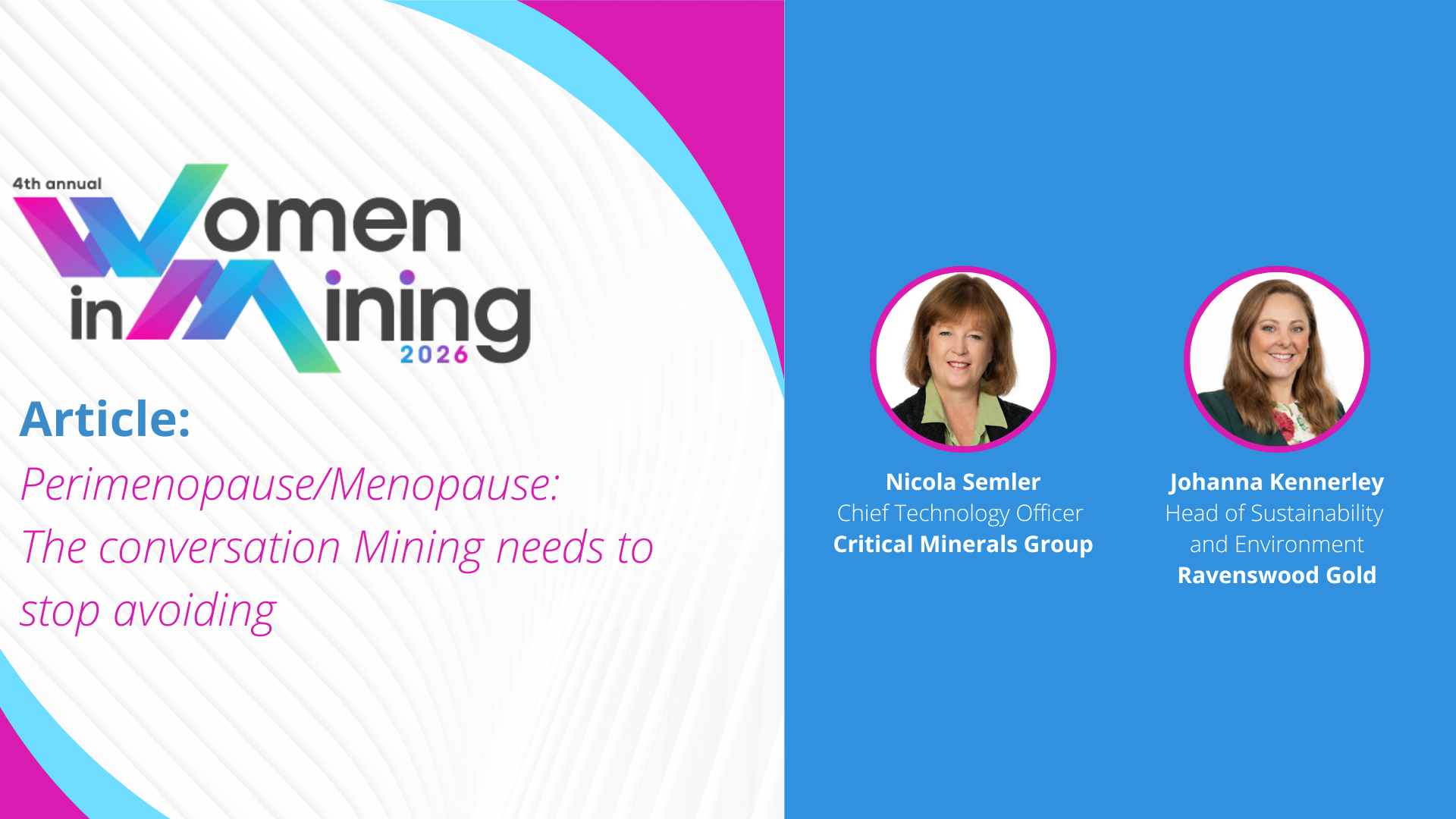
Quest Events spoke with Nicola Semler, Chief Technology Officer at Critical Minerals Group, and Johanna Kennerley, Head of Sustainability and Environment at Ravenswood Gold, to gain their insights into this issue ahead of the 4th annual Women in Mining Summit 2026.
Why this, why now?
"It is not that long ago that women in Australia were still not allowed to go underground."This is the first time in the history of mining globally that there has been a significant cohort of women in the workforce going through this health transition.
“It is not that long ago that women in Australia were still not allowed to go underground”, notes Semler. “Our efforts towards gender-inclusive workforces have been uneven and slower than they could have been, and there is still a tendency in some businesses to dismiss or minimise anything that men cannot relate to or have not experienced directly themselves (and a lack of willingness in many cases to try and understand).”
No one-size-fits-all
“Part of the issue is that perimenopause is different for everyone, and it is not something that is widely discussed or understood across general society”, Semler continues. “Symptoms can go on for years, and the range and combination of symptoms is almost unlimited. There are over 100 different symptoms that can be experienced, from minor to physically and mentally debilitating. In many cases, women can be unaware that what they are experiencing is due to hormonal changes within their bodies and not external factors or work stress (although these can definitely make certain symptoms worse).”One of the issues, Semler notes, is that women start to question their own capabilities when people around them (men and women) see a change in performance which they do not understand and/or cannot relate to. And women do not speak up because they do not understand what is happening to them, or because there is still significant stigma associated with it.
“For me, perimenopause was deeply challenging over quite a long period, but post-menopause is fantastic! But I will say that even post-menopause for some women can be very challenging. Nothing is simple here, and that is probably the key takeaway: there is no silver bullet or one-size-fits-all fix.”
The next retention cliff
“I think we have made decent progress on supporting women in mining earlier in their careers with stronger parental leave and better flexibility (certainly though, not in all roles)”, says Kennerley. “[Peri]menopause is the next major drop-off point, happening just when women are stepping into or are in senior leadership roles.”But what is the industry actually losing in terms of dollars and know-how when a woman with 25 years of experience walks away in her late 40s or early 50s?
“In many cases, employers are losing someone who is confident in her knowledge and ability to apply her capabilities effectively and efficiently; someone who has learnt from past mistakes (her own and those of others)”, says Semler. “Someone who is less afraid of ‘failure’ and far less interested in what other people think. Someone who is more willing to take risks, but those risks have been well-calculated and thought through.
These early retirements cost the industry millions in terms of lost institutional knowledge, lost technical knowledge and safety judgement built over years, lost cultural stability, loss of team cohesion and leadership, loss of thought diversity, and the loss of corporate memory that you simply can’t replace.
Talking about symptoms without it being a career-killer
In a culture that prizes "toughness", how do we make it safe to talk about symptoms like fatigue and brain fog?
“It always starts with education, coupled with honesty and vulnerability”, says Kennerley. “We need a cultural shift to normalise it as a health issue and not a personal weakness.”
Semler agrees that we make it a part of the conversation, the same way we have approached mental health in mining.
"We need a cultural shift to normalise it as a health issue and not a personal weakness."“We need to hold information sessions for the entire workforce on what perimenopause is and what it is not, how it can affect people and how it can be managed effectively. We make it clear that it affects everybody: it can be extremely challenging for the women going through it, but also people around them who do not understand the changes in behaviour and the fact that much of what occurs is not something a woman can just “deal with” or “switch off” at will.
We also need data. “We need to talk to the women in the sector who are experiencing or have experienced it. We can then start collecting real-life data and properly structured research, gathering direct insights from women on what they tried, what did and did not work, and what they think could have been done differently.”
Should we include male colleagues in the conversations?
Not at first, advises Semler:“From my work with WISER (Women in Sustainable Energy and Resources), I’ve learnt the conversation is much different when there are only women in the room. So if we want to know the real truth, get women talking to women they trust and then transfer that information (without massaging it to make it ‘more palatable’) to the people who have the power to make decisions, create policy, implement change.”
The gap between DEI talk and delivery
Kennerley believes the only way to make change real and useful is through education and understanding.“Without it, a corporate policy will have limited success, and may not be used if the cultural shift doesn’t happen at the same time”, she says. “It’s a bit like men taking parental leave - the policies have been around for a while, but the data shows that take-up of the leave entitlements is not as strong as it could be.”
“Absolutely, there is a gap”, says Semler. “A big part of the problem is that corporate policies can be written and approved independently of any input from the people who are directly affected. So a good starting point is to address that. Then, start having those conversations. Ask women doing 12-hour shifts in the Pilbara what they need and what they think will help. Not everything will be able to be practically implemented, but something is better than nothing. We need to try and fail to ultimately try and succeed in figuring out what does and does not work.”
Treating perimenopause/menopause as a standard operational health issue
“Australian miners manage heat stress well. We are becoming stronger in supporting mental health. Potentially, we could reframe perimenopause/menopause as a similar operational risk and manage it within that framework”, suggests Kennerley. “Take fatigue, for example. We manage it very well as an operational issue, and it is one of the key symptoms of menopause. We need to make sure that women suffering this symptom feel supported to use the organisation’s fatigue support, as would be the case for any other reason for fatigue.”Semler again stresses the need for education and information sessions. “It is about having open and honest conversations. There is some pretty basic stuff we can be doing right now. We do not need lengthy, expensive consultant reports to tell us there is a problem and to treat people kindly! If a site is getting it right in terms of psychosocial safety, then they are creating a climate in which it is safe to speak up. These companies are already a long way along the path of becoming a workplace that is perimenopause/menopause friendly.”
What good looks like
What does a menopause-friendly mine site look like in practice, and who is doing it well right now?
“Sadly, I don’t know of anyone who is doing it well”, says Semler, “but maybe that is also part of the problem in that no one is really talking openly about what they are doing/have done and what is working/not working.” She adds that this is not something that should be treated as a competitive advantage: “I believe it sits in the space of fundamental human rights: the right to not be discriminated against because of something outside of your control.”
"… it sits in the space of fundamental human rights: the right to not be discriminated against because of something outside of your control."“Having said the above, there is a very strong relationship to culture here. When I was experiencing perimenopause, the ability to tell my team on site that I was having a challenging day and not have them judge me for it was bigger than you can imagine. The power of humour is incredible; we sometimes call it a ‘cranky pants’ day. It did not give me the right to be obnoxious without consequence, but it did create a space where I wasn’t judged if I did snap at someone or I needed more time than usual for decision making (brain fog) or to collect myself (emotional rollercoaster) or whatever other accommodation was needed at the time (again, within reason).”
Semler reiterates that if a site is getting it right in terms of psychosocial safety, then they are creating a climate in which it is safe to speak up.
Kennerley lists more attributes of a perimenopause/menopause-friendly site:
“It would be compassionate, educated, and flexible. It would have leaders who are trained in this issue and are comfortable having conversations about it. And (as a starting point), it would have clear policies using existing supports for menopause symptoms. I think most organisations are on the journey, but no one is really at the forefront at this point.”
From avoidance to action
The business case is clear. Retaining experienced women costs far less than replacing them. Simple interventions like education, open conversation, using existing fatigue and psychosocial frameworks, and listening directly to affected women can deliver significant retention and productivity benefits.Mining cannot claim to be serious about retaining its most-experienced women while avoiding the conversation about perimenopause/menopause. It is time to have it: openly, practically, and with clear commercial intent. Join Nicola Semler, Johanna Kennerley and other thought leaders in the sector at Women in Mining Summit 2026.
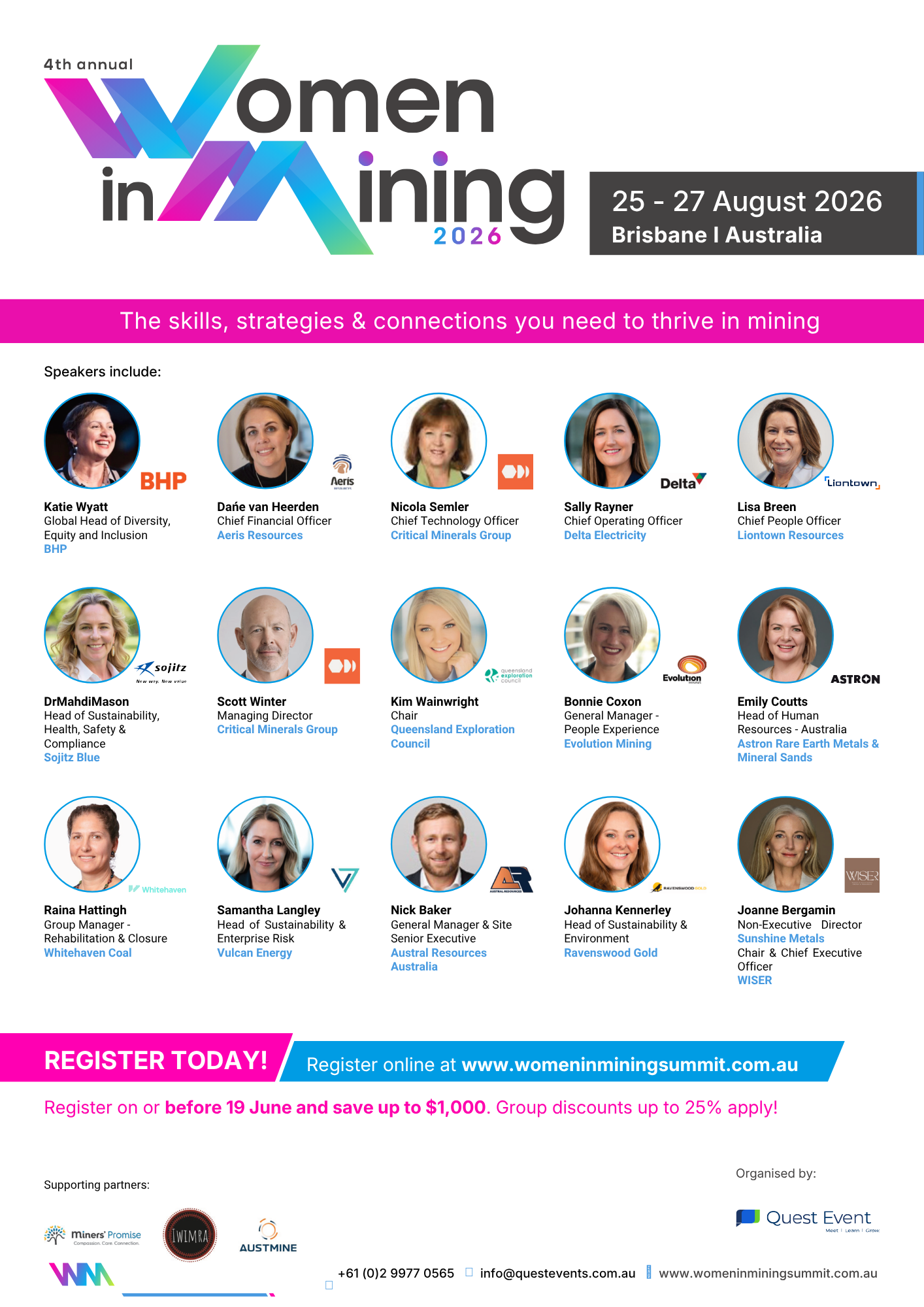
Download the Brochure
Find out what to expect at Women in Mining Summit 2026!