
.png?width=1920&height=1080&name=WIMs%202026%20Article%20Post%20(2).png)
“Mining is Australia’s best-paid industry with top-quartile workers averaging $316,752 a year. Almost none of the women in the sector are among them, and the industry’s distance from the rest of the economy is widening.”
The top quarter of earners in Australian mining take home an average of $316,752 a year, nearly triple the $120,661 earned at the bottom of the same industry. Who occupies which end of that divide is not random. Women make up 23 per cent of the mining workforce but just 17 per cent of its highest-paid quartile, resulting in a gender pay gap of 21.1 per cent in the country’s richest sector.
Here is the number that should worry mining boards more: 81 per cent of mining employers now have a pay gap above the national benchmark of 11.2 per cent, according to the Workplace Gender Equality Agency’s 2024-25 data, and that share grew six percentage points in a year, the sharpest deterioration of any industry. The rest of the economy is pulling away, and mining is falling further behind it.
This is despite, or perhaps because of, the sector’s enthusiasm for paperwork. Some 91 per cent of mining companies have a formal policy on equal remuneration, well above the 74 per cent national average. The distance between that statistic and the 21.1 per cent gap is the story.
The gap is a map, not a payroll error
None of this means women in mining are being paid less than men for the same job. That’s been illegal for five decades, and where it occurs it is the most readily fixed of the pay gap’s drivers. The pay gap compares the average earnings of all men against all women, and in mining that comparison draws a map of who holds which jobs. Women cluster in administrative, support and corporate functions. Men fill the operational, technical and senior roles where the money is. These are the roles that also attract the site allowances, overtime and bonuses that can add 15 to 25 per cent to a package.
Those discretionary payments deserve particular scrutiny. WGEA’s report describes them as “rarely objective”, and men-dominated industries carry the largest bonus-and-overtime gaps in the country, gaps that barely moved this year.
Mary Wooldridge, the former WGEA chief executive who fronted the report’s release in March before her term ended, put it bluntly: the dominance of men in the best-paid roles and women in the lowest-paid ones should serve as “a reality check for anyone who thinks Australia has achieved equality in the workplace”.
“The uncomfortable arithmetic for mining boards is that an equal remuneration policy addresses the problem the industry has largely already solved, identical pay for identical roles, while leaving untouched the structural conditions that aid in generating the gap.”
Why the policies aren’t working
The uncomfortable arithmetic for mining boards is that an equal remuneration policy addresses the problem the industry has largely already solved, identical pay for identical roles, while leaving untouched the structural conditions that generate the gap: recruitment pipelines, promotion pathways, the design of site-based work, and who gets offered the overtime.WGEA’s data shows how thin the follow-through is. Fewer than a quarter of employers who examined their pay gap did so comprehensively, and only one in five turned what they found into an action plan. A policy without that machinery is a mission statement, not a mechanism.
Wooldridge’s parting prescription was that employers treat gender equality like any other business goal: diagnose in detail, act on the diagnosis, and make someone accountable for the result. The sector is improving, with most mining employers narrowing their gap, but it is improving from the back of the field.
The miners moving the needle
The variation between the majors is where the lessons live. Rio Tinto reports a base salary gap of effectively zero, with its remaining total remuneration gap attributed almost entirely to women’s under-representation in allowance-heavy operational roles. BHP has ground its way to 36.9 per cent female representation in its Australian workforce, up from 33.4 per cent in a single year, through deliberate recruitment targets rather than aspiration.What distinguishes these companies is not better policies. It is that they treated composition as the problem: numerical targets, redesigned rosters and site facilities, re-entry pathways after parental leave, and audits of who actually receives the bonuses. Yet only 27 per cent of employers nationally have set a target to reduce their gap, a choice that stops being optional this year, when new laws require employers with 500 or more staff to set and meet gender equality targets or demonstrate improvement over three years.
Enforcing that regime falls to Christine Castley, who took over as WGEA chief executive in May and has already signalled where her attention lies. “Australia didn’t grow new capability; Australia discovered capability it had overlooked,” she said in her first public address in the role, arguing today’s barriers are “culture, assumptions and systems designed for another era”. For mining companies still pointing to the policy on the shelf, the message is simple: the document was never the destination. The workforce is.
Christine Castley is joining the 4th annual Women in Mining Summit 2026 being held in Brisbane August 26 – 27 2026, where she’ll be discussing ‘What the gender pay gap data is really telling us and what the industry needs to do about it.
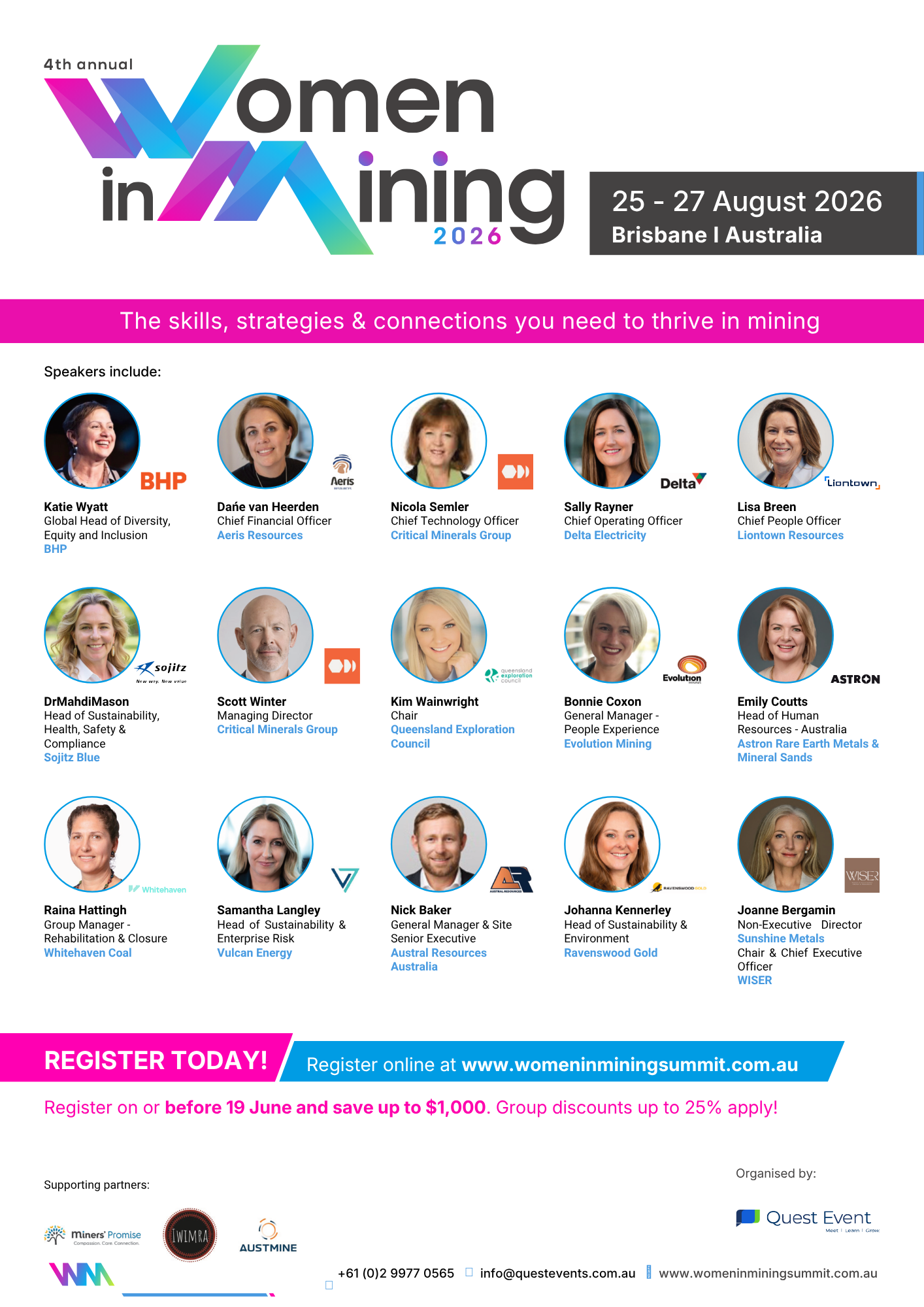
Download the Brochure
Find out what to expect at Women in Mining Summit 2026!